Friday, 22 March 2013

Creamy Cauliflower and Roasted Fennel Soup


This is probably my favorite of the soups that I have made. It is so simple and filled with a variety of delicious, white vegetables. If you blend it enough it should be super smooth and the fennel should add a substantial yet soft component. 

When I was a kid, my favorite of all of the Campbells cream soups was the cream of celery. I liked the texture and the flavour of the soft celery in the creamy broth. This soup reminds me of that, actually this soup was inspired by Campbell's cream of celery as disappointing as that may sound.


A bonus to this soup is that there is no dairy in it, but it is still super creamy. It is also completely vegan; something I am still trying (but struggling) to be. I have been eating out a lot, and in an attempt to not be annoying, I have been complacent in eating things that likely contain some form of dairy or eggs. My best and most cowardly strategy may have to be to stop eating out and find more delicious vegan things to make at home, which also means finding more time to cook.

As I write this, I am at work, at 7 pm, waiting for an experiment I am running to complete so I can clean up and go home. This working late pattern has me drawing up huge lists of beautiful looking recipes but leaves me with little time to actually test any of them out. 


My gramma said something interesting to me while I was visiting her this past weekend in Winnipeg. She expressed that the whole business of eating is just a nuisance; that we would have a whole lot more time on our hands if someone would just invent a pill that we could take which would provide us everything we need to survive.

It frightens me a little to think how much extra time I would have to waste if I did not have to eat. No more looking at recipes, or planning meals, or writing blog posts, or shopping for groceries, or going out for dinner - never mind the actual cooking and eating part of it all. I imagine we would all go crazy if we did not have cooking and eating to think about - or maybe we would just all be a whole lot better at doing a lot more things. Until then, I will keep at wasting my time doing the aforementioned food-related activities whenever I can.


Creamy Cauliflower and Roasted Fennel Soup


Ingredients

  • 2 tbsp extra virgin olive oil, divided
  • 1 leek, chopped
  • 2 parsnips, peeled and sliced
  • 1 garlic clove
  • 6 cups of water (or more)
  • 2 bouillon cubes (no MSG)
  • 1 head of cauliflower, chopped
  • 2 small fennel bulbs, trimmed and chopped
  • Reserved, chopped fennel fronds (the part that looks like dill) to garnish
  • Sea salt to taste
  • Sweetener (agave or honey), to taste (~ 2-3 tsp) 

Directions
  1. Preheat oven to 375F.
  2. Heat 1tbsp of olive oil in a large soup pot over medium heat. 
  3. Add chopped leek, parsnip and garlic.
  4. Sautee for 8 - 10 minutes
  5. Add cauliflower, water and bouillon cubes. The water should just cover the vegetables, so adjust water volume as required.
  6. Bring soup to a simmer and cook for about 20 - 30 minutes - until cauliflower is tender.
  7. Meanwhile, toss the chopped fennel in 1 tbsp olive oil and season with ground sea salt.
  8. Spread the fennel on a baking sheet lined with parchment paper.
  9. Roast the fennel for 10 minutes, toss, then continue to roast another 10 minutes until just soft but not brown (slightly browned is okay).
  10. Working in batches, puree the soup (without fennel) in a blender until smooth.
  11. Return the soup to a pot.
  12. Stir in roasted fennel and season the soup with sea salt and sweetener.
  13. Serve the soup warm and garnish with chopped fennel fronds. 

Thursday, 21 February 2013

Vegan Roasted Squash and Tarragon Biscuits


One of the toughest parts about turning 30 is knowing you have reached an age where many of the things that you thought you eventually would do, you probably, actually, will not. Taking singing lessons, getting a black belt in Karate, becoming a great painter and re-learning calculus are some things I will most likely not have time to do until retirement. 

Not being shy anymore is something else I thought I would have accomplished by this time in my life. I have definitely made serious progress compared to the mute and socially terrified human being I once was. There was a time where the idea of presenting at conferences, defending my thesis, teaching classes and passing job interviews seemed impossible and unimaginable  Although these events tend to keep me up at night in anticipation, I somehow managed to trudge through them all, ending up a stronger and braver person on the other side. 

But I still find myself in many situations where I am reminded that the timid girl I once was is still a part of me, and for some reason, she is usually the first person on the scene in a stressful situation. Having recently started a new job, I am constantly being thrown into situations where I have to converse, plan and present to people who I am not only not familiar with but also intimidated by. Trying to relax and hide my nerves is something I have to continually work at, but I am determined to keep pushing myself and hope that some day I can enter any unfamiliar setting with confidence and ease.


Something else that I am finding more mentally taxing than expected is a creative writing class, which I attend on Tuesday evenings. I did not picture myself feeling shy in this class when I signed up for it. Everyone is just there to learn and develop their creativity; there are no grades, no co-workers, no job prospects and no competition. I love the class and the opportunity it gives me to practice my writing in a completely creative context. I am expected to write everyday and am given a multitude of writing assignments that inspire me to write freely and explore my unconscious. 

The hard part comes when I have to read my work out loud in class and also give verbal feedback to other's stories and poems. Being socially anxious seems to be a deep rooted personality trait, an innate reaction to uncomfortable situations, that I cannot completely shake. At the end of a class I find myself somewhat drained and deflated; discouraged by my fear of being outspoken. 

On the flip side, I also feel slightly thrilled knowing that I am pushing myself. Every time I speak out loud - as embarrassed as I feel afterwards - I know I have taken one more step towards my goal of someday completely overcoming my shyness.


Changing eating habits is another thing that just seems to get more difficult with age. One of the hardest parts might be having to get those who surround us to support and get on board with our desired changes. This is the challenge I am facing with trying to convince Mike that my switching to a vegan lifestyle wont affect him very much. I am determined to show him that we can enjoy our food just as much now as we did before, by cooking as many delicious vegan foods as I can.

Biscuits are actually the first thing that came to mind when I thought about cutting dairy out of my cooking. I make biscuits a lot. And every time I make them I wonder - how am I going to make these taste good if I omit yogurt, milk, butter and a whole cup of grated cheese from the recipe? Well, I tried. And so far this is what I have come up with. 

All of those dairy products listed above have been replaced by coconut oil and coconut milk. A flavorful fresh herb is a critical ingredient for adding flavour. The squash is also an important flavour component and just the right amount of salt and a touch of sweetness is needed. One really handy thing about going vegan is that you can taste literally anything you are making, before you actually cook it. This helps big time in making sure you dont mess up the seasoning of a dish before you cook it, which is especially handy with baking. As you are mixing up the ingredients, give the dough a little taste. If you are not satisfied, try drizzling in a little more sweetener or stirring in some more herbs or even finish the biscuits with a little sprinkling of fleur de sel.


Vegan Roasted Squash and Tarragon Biscuits

Ingredients
  • 2 cups all purpose flour
  • 1 tbsp baking powder
  • 1 tsp baking soda
  • 1.5 tsp fine ground sea salt
  • 1/3 cup coconut oil (solid)
  • 1/4 cup chopped fresh tarragon
  • 2/3 cups roasted squash*
  • 2/3 cups of light coconut milk
  • 1.5 tbsp agave syrup

Directions
  1. Preheat oven to 400F (preferably with a baking stone on the middle oven rack).
  2. Mix the flour, baking soda, baking powder and sea salt in a large bowl with a fork.
  3. Add the coconut oil to the flour in pieces. Use your fingers to break apart the coconut oil into the flour and mix it around in the flour until the flour takes on a grainy appearance.
  4. Mix the chopped tarragon into the flour.
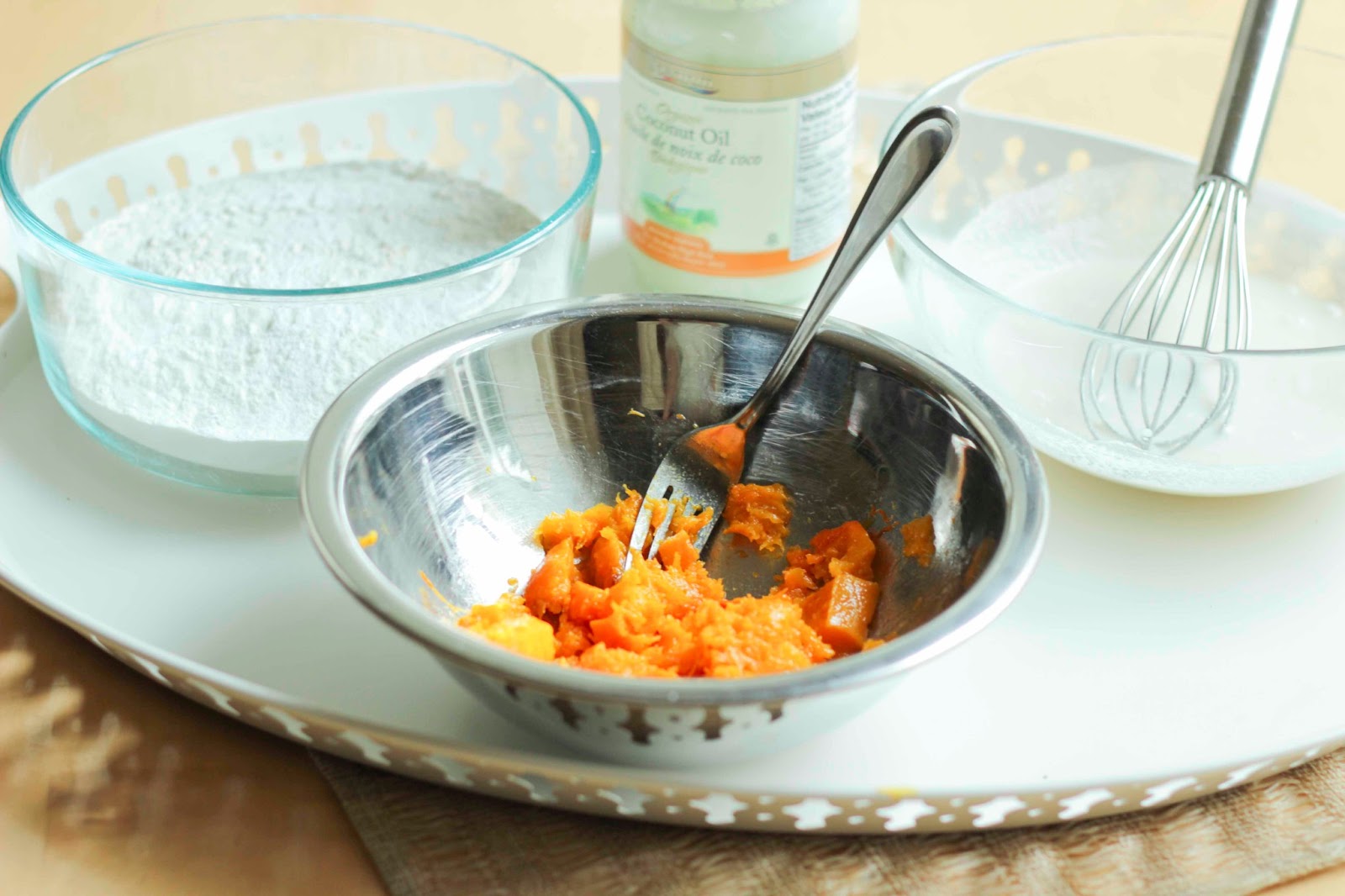
  5. Roughly mash the roasted squash with a fork and mix into the flour.
  6. In a separate bowl, whisk together the coconut milk and the agave.
  7. Next, add the wet mixture into the flour mixture and mix it in. The dough may seem very crumbly at first.
  8. Turn the mixture out onto a counter surface and work the dough until everything just begins to hold together and is well mixed.
  9. Lightly flour the counter and then flatten out the dough with your hands into a 1/4 inch thick round.
  10. Cut the round in half, pick up one half of the dough and put it on top of the other half of dough.
  11. Flatten the dough out again, pressing gently with your fingertips and sprinkling with flour as needed.
  12. Repeat steps 10 and 11 two more times, cutting the dough, layering it on top and flattening it again. This does not have to be neat and tidy, the squash in the dough will likely stick to your fingers as you try to flatten out the dough.
  13. Once you have the dough flattened out for the third time, use a small round cookie cutter or cup to cut out 1.5 -  2 inch diameter rounds from the dough.
  14. Place the biscuits onto a baking sheet lined with parchment paper. The parchment paper is important for ensuring the bottom of your biscuits do not burn - especially if you are using a dark baking pan.
  15. With the leftover dough, gather it back together and cut out more biscuits. Then with the final scraps, just form rough round biscuits by shaping the dough with your hands.
  16. Bake the biscuits about 6 - 10 minutes - depending on the heat of your oven and the size of the biscuits the time will vary. I suggest looking at them after 6 - 7 minutes. Once they start to brown you can remove them from the oven.
  17. Allow the biscuits to rest 10 minutes before serving.
*To roast the squash: toss peeled and cubed squash pieces with a drizzle of olive oil, sea salt, and a crushed/ minced garlic clove. Lay out slices on a baking sheet lined with parchment paper. Roast about 20 minutes, until soft, at 400F, flipping the slices once after about 10 minutes. Let cool.

Tuesday, 12 February 2013

Vegan Breakfast Sandwich (with Potatoes, Smoked Tofu and Avocado)


Testing the vegan waters these past couple of weeks admittedly has not been as easy as I anticipated. For the first few days I found that I was essentially always hungry. I had trouble thinking of what to eat and could not constantly snack as I usually do because there was nothing vegan in my house to snack on. I realized that sticking to my goal would require some preparation and pantry stocking. 

The first challenge I faced was breakfast. Weekdays were easy to handle because I eat the same thing every morning - plain oatmeal with agave and blueberries - done. But on weekends I usually make elaborate, egg-centred meals and finding alternatives is vaguely dejecting. Eliminating bacon several years ago was easy enough, but a breakfast without eggs is nearly impossible to find - especially if you are eating out. 

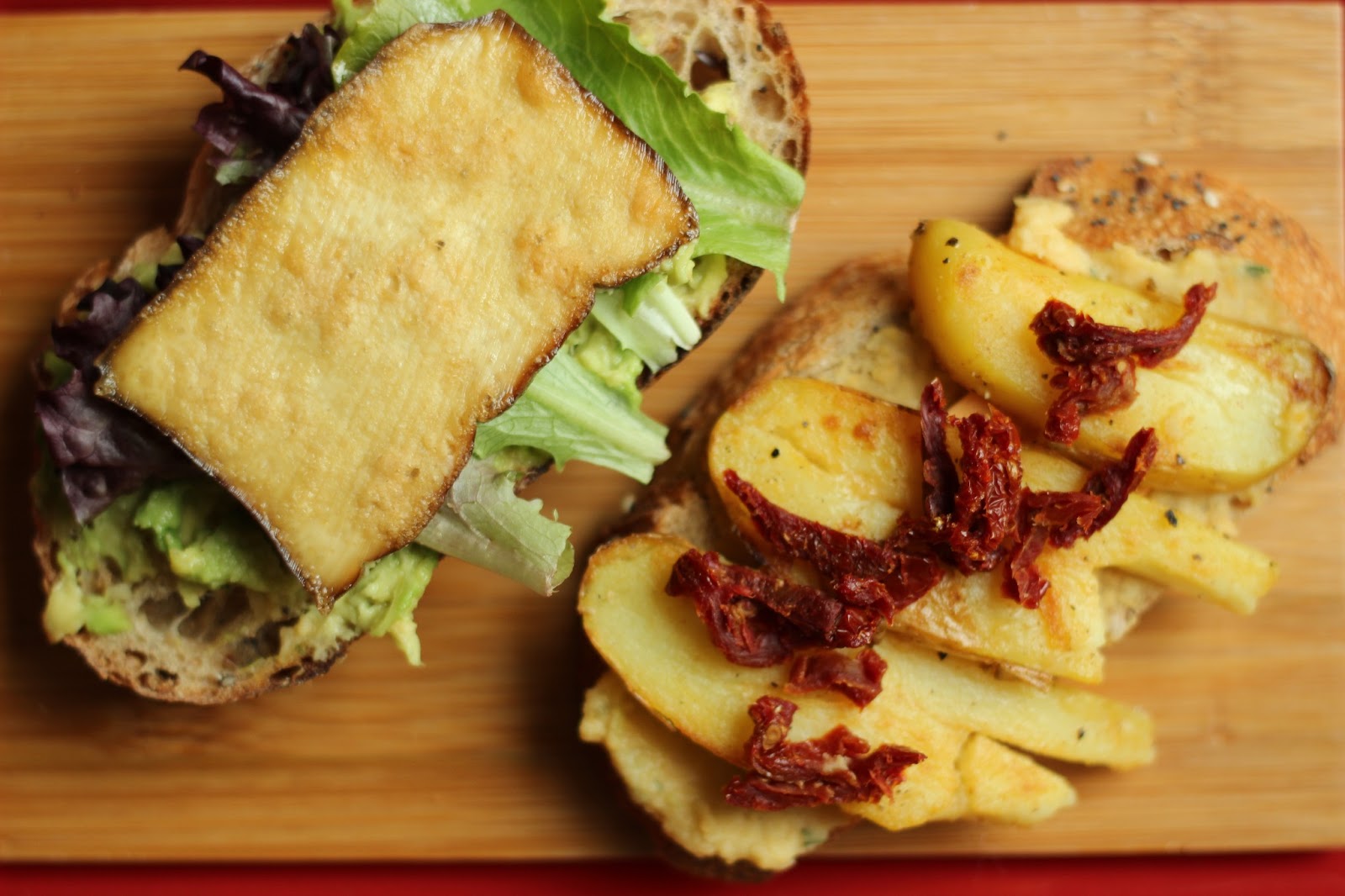
My first vegan weekend started with the breakfast sandwich described here. The only standard breakfast item left for a vegan, that I can think of, is potatoes. I have had some delicious breakfast wraps that had potatoes in them - so I thought adding them to a sandwich would give them a breakfast feel - as opposed to being just another sandwich. 

One morning I also went for breakfast at Slickly Jims, a restaurant on Main Street. There was literally only one vegan item on the menu, a tofu scramble, although they have a wonderful selection of vegetarian options. I ordered the modest sounding tofu scramble and was relieved to find it enjoyable - the texture of the tofu was soft - like lightly whisked, soft scrambled eggs. The scramble was perfectly seasoned and flavoured with chili and sesame oil. With it came seasoned potatoes, marble toast and a homemade berry jam. 


The next morning I made a scramble of my own but without tofu or eggs. Instead I used potatoes, mushrooms and peppers and topped it with a variety of diced fresh herbs and chopped avocado. I served the scramble with some vegan biscuits and sliced fruit. The vegan biscuit recipe is something I have made twice in the past ten days but the recipe is not quite perfected. I have not yet found the right ratios of coconut milk, roasted squash and flour. I also made a creamy vegan fennel, cauliflower and parsnip soup - also soy and dairy free - actually it was made with 100% vegetables. I am really excited to perfectly tweak the ingredients and share that recipe.

Other than what I have described here, I have had many salads with roasted veggies, soba noodle bowls with tofu and veggies and peanut sauce, vegetable soups, lots of melon, oranges and other fruit and too many pistachios and cashews.

Over the next few weeks I want to get into using more beans - there are a gazillion heirloom varieties at whole foods that I am excited to play with - and I think it is time I tried fava beans. I am foreseeing veggie burgers, tacos, wraps and all kinds of bean and whole grain salads and warm single dish dinners in the near future. 

Now I am mentally tackling how to manage eating out with friends, how to say no to sharing someones granola bar, decline an offer for chocolates or refuse co-workers' home baking. So far, I have not been very good at this - not because I cannot resist but because I am afraid to see the look on peoples faces when I tell them I have stopped eating dairy and eggs - sometimes I just do not feel like explaining myself.

Also, after walking past a container of burrata at the grocery store the other day - and remembering my upcoming trip this summer to Italy - I am not sure I can 100% say no to fresh mozzarella in Italy. I might have to do some Slow Food research to figure out what animal farming in Italy is like. I am hoping to find out that Italian farming practices are not as frightening as they are here. Like I said - its not easy - but I am working on it.


Vegan Breakfast Sandwich - with potatoes, smoked tofu and avocado
The only effort in this recipe involves cooking some potatoes and smoked tofu. 
The amounts below are for 1 sandwich but obviously will vary with the size of your bread slices.

Ingredients
  • 1 - 2 small potatoes (fingerling used here)
  • 2 slices of fresh bread
  • 2 tbsp prepared hummus
  • 1/4 avocado
  • 1 or 2 slices smoked tofu
  • 2 sun-dried tomato halves
  • 2 slices daiya cheese
  • Lettuce leaves
  • Vegetable or olive oil
  • Salt, pepper
  • Smoked paprika (optional)
Directions
  1. Cook the potatoes - add to a pot covered by an inch of cool water. 
  2. Bring the water to boil, lower heat and simmer the potatoes gently until tender - about 10 minutes.
  3. Allow the potatoes to cool.
  4. Slice the smoked tofu into 1/4 inch slices.
  5. Chop the sundried tomatoes.
  6. Mash an avocado in a bowl with a fork.
  7. Slice the potatoes into 1/4 inch slices.
  8. Bring a pan to warm over medium heat and add a tbsp of oil.
  9. Add the tofu and potato slices to the pan.
  10. Season the potatoes with salt, pepper and smoked paprika.
  11. Cook potatoes and tofu until browned on both sides.
  12. Toast the bread if desired - in he oven or in a toaster.
  13. Assemble the sandwich by smearing one slice of bread with hummus, the other with avocado and adding everything else in between. Preferably the cheese should contact with the warm tofu or potatoes.

Thursday, 31 January 2013

Grapefruit, Roasted Beet and Cauliflower Quinoa Salad


I am overtly sensitive and too easily bothered by the misfortune, inequity and suffering imposed upon other living people and animals throughout the world. I avoid reading the news because if I read a story about a plane crash, a shooting or other violent crime - the details of the event push everything else out of my mind, preoccupy my thoughts and prevent me from focusing on any other task.

My theory is that my life has been too easy; I am unfairly lucky. I have never lost someone close to me, I have never been in a serious accident, I have never witnessed a violent event, was never abused, never lived in extreme poverty or thought realistically that my life was in danger. I know that I am relatively safe when I walk down the street, I have a wonderful job, I feel respected in my workplace, I have an amazing family, close and supportive friends and a best friend for a boyfriend.

I sense that, because I have been so lucky in my life, I am like an empty canvas, a sponge of sorts, for pain and empathy. I do not know what real suffering feels like and so when I am exposed to it, through the media or through the stories of others, the perceived weight of these experiences seeps into every crevice of my soul. Hearing about the details of horrid events keeps me awake at night, my mind exploding with confusion and disgust at the extent of misery experienced and inflicted by humankind.


Recently I had one such experience, whereupon I lied awake for hours in my undeservingly warm and comfortable bed as scenes from Vegucated assaulted my every attempt to fall asleep. Vegucated is a documentary following the lives of three New Yorkers who sign up for a 6 week challenge to become vegan with the intent on losing some weight and adopting healthier lifestyles. The documentary description piqued my interest a few weeks ago, but I opted not to watch it at first because I know what films centered around veganism contain - they plague you with guilt about the torturous nature of farming and the horrible impact that animal farms have on the planet.

I already know how bad these industries are because I have watched many documentaries and read many articles on this topic. So, when I pressed play, I expected to be bored. Instead, I was uncomfortably shocked as I watched horrible scenes and listened to violent accounts of the nature of life and death on animal farms. These scenes were not unlike anything I have been exposed to in the past but for some reason, seeing these images again magnified latent feelings of horror that I have experienced before. I was unexpectedly saddened, frustrated and disappointed mostly in myself for being aware of how unbearably cruel animal farming can be but somehow, over time, allowing this reality to slip from my mind so that I can comfortably enjoy eating cheese, butter and eggs.


Besides horrifying me, this documentary also made some very simple and logical arguments against using evolution and humans-are-carnivores as rationales for supporting ones desire to live on animal-based diets. It is true that at one point along our evolutionary history it was advantageous for humans to eat meat. When we moved from a strictly herbivore diet to a carnivorous diet we gained an evolutionary advantage. Meat acted as an additional food source that gave us more energy, more food options and it allowed us to spend less time seeking out food and more time on developing our wits. 

At that time in our past, it made sense for us to eat meat as there was not that many of us, and there were a lot of animals to sustain us. Presently, the only way to maintain the carnivorous diet in the human population is to automate the raising and killing of animals in farms. This practice is contributing to the destruction of the planet and, to say the least, is horribly unpleasant. 

It is also obvious that many animals are carnivores who depend on killing other animals and eating meat for survival - if their food sources were to run out, they could go extinct. Unlike these animals, we humans have an endless array of food options at our disposal. Thanks to agriculture we can grow almost any fruit or vegetable we want, we can get protein from legumes and nuts, we can make dairy-like products from soy, rice and almonds. We can make pasta, stews, veggie burgers, soups, wraps, tacos, sandwiches - we can easily survive - without animals and it is important that we at least try to do so for our own health, for the respect of our animal friends and for the longevity of the planet. Albert Einstein once famously said: "Nothing will benefit human health and increase chances of survival for life on earth as much as the evolution to a vegetarian diet."


I do not expect other people to change their lifestyles based on this or any other strategically placed argument - or even after seeing the distubing images that dropped me into this conflicted state of mind. But I personally have had enough of the insanity that is farming in North America. I have reached a point where I have to at least try to live without eating animal products. I dont expect it to be easy. I already put milk in my coffee yesterday without even thinking about it, but I am determined to try; even if just to help my conscience sleep at night.

I made this salad, actually, before watching Vegucated. When I made it, I also thought about adding goat cheese and avocado but found it to have so many flavours already that I stopped after roasting cauliflower and beets and adding spinach, grapefruit and thinly sliced almonds. The grapefruit I used made the dish slightly sour, so the grapefruit you use could have a big impact on how much you like this dish. An orange or even chopped apples would also be a good option if you prefer to stay away from the sour grapefruit.


Grapefruit, Roasted Beet and Cauliflower Quinoa Salad
See this post for handy quinoa cooking tips

Ingredients
  • 2 medium golden beets (peeled and cubed)
  • 1/2 head of cauliflower (chopped into small florets)
  • 2 garlic cloves minced
  • Extra virgin olive oil
  • Fine sea salt to taste
  • 1 cup quinoa, rinsed
  • 1/2 cup vegetable bouillon (I like Harvest Sun)
  • 1 cup spinach, chopped
  • 1 grapefruit, segments, chopped, juice reserved
  • Sliced almonds to garnish

Directions
  1. Preheat oven to 400F.
  2. Add beets to a pot and cover an inch above the beets with cold water. 
  3. Heat the water on the stove, bring to a boil and simmer the beets until tender-firm (test by piercing with a fork), 2-5 minutes.
  4. Drain the beets, keeping 1.5 cups of the hot water in a bowl.
  5. Add the beets to a mixing bowl with the cauliflower florets. Drizzle in 1 - 2 tbsp of olive oil, minced garlic and season with sea salt. Mix well to coat.
  6. Spread the cauliflower and beets on a baking sheet lined with parchment paper.
  7. Roast the vegetables for about 20 minutes or until the cauliflower starts to brown - turn the vegetables about halfway through the cooking time.
  8. Meanwhile, add the beet water back to a pot with 1/2 of an organic vegetable bouillon cube. 
  9. Bring the water to boil, dissolve the bouillon and stir in the quinoa. 
  10. Cover, lower heat and simmer the quinoa for about 15 minutes.
  11. Drain the quinoa well (about 10 minutes) then add to a bowl. 
  12. Stir in the grapefruit, reserved juice, cauliflower, beets and spinach. 
  13. Cover and let rest at least 15 minutes before serving - or store in the fridge until ready to eat.
  14. Serve garnished with thinly sliced almonds.

Wednesday, 23 January 2013

Roasted radish and broccolini salad


Although I am no nutritionist or dietician I have to say that I am a strong skeptic of any fad diet with a fancy name, tricky claim or alleged scientific justification. I think in this embarrassing age of chemically processed foods, couch potato lifestyles and overwhelming obesity there is a vast excess of vulnerable and suggestible people waiting to be convinced to spend money and change their lives on the premise of technical jargon and terminology just beyond the grasp of their understanding.


One term that really aggravates me because I know it sounds like it makes a lot of sense but really it is a made-up idea is that of “detoxifying”. Obviously, if someone tells us that our bodies are filled with toxins and that we can purge these toxins from our body by starving ourselves or taking laxatives or eating honey and cayenne pepper we might be tempted to believe them. Toxins sound horrible and imagining them in our body, bouncing around and shortening our lifespans and causing disease is aggravating enough to lose sleep over. But the reality is that these so-called toxins that fad diets claim to be targeting are vague and ill defined. I could go into details, but if you simply look up the word toxin in Wikipedia you will get a sense of how there really is no scientific understanding of the type of toxins that fad diets claim to be a remedy for.

The other fad diet that causes me a small amount of distress and frustration is the Paleo Diet. I will admit up front that I do not disagree that this diet will benefit those who have the willpower to stick with it; what I do not agree with is the premise of the diet that I feel is used to make people think it has a a strong sound scientific basis. 


In case you are not familiar with the Paleo Diet, let me enlighten you. As the name suggests the Paleo Diet is restricted to the foods that our ancestors ate during the Paleolithic period, an era spanning 2.5 million to 10 000 years ago. The Paleo Diet consists of eating everyday modern foods that our pre-agricultural, hunter gatherer ancestors ate during this time period. The rationale for eating this way is centered on the notion that our current genetic makeup was shaped by our evolution during the Paleolithic era. The claim is that our current genetic makeup is ideally adapted to a diet consisting of protein primarily derived from animals and fish, and of carbohydrates and fiber coming from fruits, roots, fungi and vegetables.

I cannot deny that this explanation does sound fancy and I understand how people are easily drawn into the idea, but I also find the rationale to be very narrow-minded and the diet unreasonably restrictive. No one, least of all myself, can argue with the notion that we would all be a lot healthier if we consumed only natural foods such as fish, fruits and vegetables. The fact that processed foods, refined carbohydrates and sugars are linked to poor health is well-known. But research also shows that legumes, whole grains and even dairy can have positive health benefits, all of which are forbidden on the Paleo Diet. The truth is, you can probably find research supporting or arguing against the positive and negative effects of almost any food item of your choosing.

But with so much information available at our disposal, restricting ourselves to a diet that we sustained ourselves on a million years ago because we are convinced that our genetics are ideally adapted to that lifestyle seems very naive. Many life forms are extremely adaptable in ways we never thought possible and thinking we can predict the limits of an organism based on what we know about its genetics really puts life into a box with boundaries built out of subjective reasoning rather than reality.


One idea that really exemplifies this notion for me is the fact that the genetic material encoding our brains today is also almost exactly the same as that of someone born in the Paleolithic era. If someone born 50 000 years ago was raised in today's society there is no reason they would not be as advanced or as smart as any other average human being. It would be impossible to predict our limits today based solely on how we lived in the past. Our genetics are only a piece of the puzzle that determines who are and who we can be - the environment we live in also has an undeniable impact.

Although our genetics have evolved very little in the past 10 000 years, some things have actually changed. The majority of people now carry mutations in their DNA that have increased their capacity to utilize dairy as a food source compared to our pre-agrarian ancestors. In addition to the subtle alteration of our genetics, our environments have also changed - drastically. A Paleolithic diet is no longer capable of supporting the survival of the human race. Agriculture is now an integral part of our society and we would not be here without it. No doubt some of the directions we have moved in have been for the worse but we have to choose our paths taking into account the plethora of information we have accumulated along the way.

With all of the knowledge we have at our disposal it is clear that the motivations for our life choices should be more profound and routed in our own experiences and sound research rather than in the claims touted by someone trying to make money and fame off of a clever idea.

And with that, I present you with another salad. You should eat it because it is good for you, because it is made with greens, roasted veggies, nuts and a simple homemade dressing.


Roasted radish and broccolini salad
Makes 2 large or 4 small salads
Broccolini can be easily substituted with regular broccoli in this salad and cara cara oranges can be replaced with grapefruit or other sweeter oranges.

Ingredients

  • Mixed greens (arugula, spinach etc) 
  • 1 bunch radishes (~10), trimmed and cut into quarters 
  • 1 bushel brocolini, trimmed and cut into 2 inch pieces 
  • 1 tbsp olive oil 
  • 1 garlic clove, minced 
  • sea salt 
  • 1 cara cara orange, cut into 1" cubes 
  • 1/4 cup hazelnuts, chopped 
  • Goat cheese
  • 3 tbsp extra virgin olive oil 
  • 1 tbsp meyer lemon juice 
  • 1 tbsp white balsamic vinegar or (white wine vinegar) 
  • Dash of honey to taste 
  • Sea salt 


Directions
  1. Preheat oven to 400F. 
  2. Mix the chopped radishes and broccolini with crushed garlic and 1 tbsp of oil and season with sea salt until evenly coated. 
  3. Spread the vegetables onto a baking sheet lined with parchment paper. 
  4. Roast the vegetables for about 15 or 20 minutes, until the broccolini leaves start to brown - this is the part that will cook the fastest and you do not want it to burn. 
  5. Toss the vegetables once after about 10 minutes. 
  6. Meanwhile, make the dressing by shaking the 3 tbsp of olive oil with meyer lemon juice, balsamic vinegar, honey and sea salt in a small jar or plastic container. 
  7. Remove roasted vegetables from oven, allowing them to cool slightly before serving salads. 
  8. Place a handful or two of lettuce leaves into the bottom of 2-4 plates or wide bowls. 
  9. Top lettuce with the sliced orange segments, slightly warmed and roasted vegetables, crumbled goat cheese and hazelnuts. 
  10. Dress the salad and serve. 

Sunday, 6 January 2013

Tomato, leek and barley soup with japanese yam and kale


The Lure of lycopene


Arguably one of the greatest accomplishments of the last century was the control of infectious diseases in the developed world owing to the discovery and development of vaccines, antibiotics and other antimicrobial agents (CDC). With the advancement of microbiology and the reduced impact of harmful bugs on the lifespan of human beings, other threats to human health have emerged including cancer, diabetes and the number one killer - heart disease. 

Genetics and age have an immovable impact on our cardiovascular systems but countless other environmental factors also impact the health and longevity of our hearts.  The biggest environmental factors contributing to the decline of our central, blood pumping organ is lack of exercise, weight-gain, low fruit/vegetable consumption and smoking - all of which we do have control over when it comes to our fitness. Unfortunately, for many, tackling these issues is easier said than done.

Another inconspicuous player in cardiovascular health is carried inside the bellies of one of my favorite foods, the tomato, and is called lycopene. Watermelons, guava, grapefruit and papaya are other great sources of lycopene. One early sign that lycopene might positively impact our heart was the knowledge that in regions of the world where a Mediterranean diet is consumed, there is a decreased risk for heart disease compared to the rest of the world. Tomatoes are a major component of the Mediterranean diet that was found to contribute to this decreased incidence of heart disease and lycopene is abundantly present in this fruit.

Lycopene is a molecule that is classified as a carotenoid. Carotenoids are natural pigments that are produced by plants and often contribute to the particular colour of a fruit or vegetable.  Each carotenoid has a specific structure that contributes to the pigment associated with it.


The characteristics of carotenoids do not end in their colour however; in plants they are responsible for absorbing light which is used to make energy and they also protect the plant's energy-making machinery from damage. In people, carotenoids play a similar protective role as an antioxidant, meaning they absorb harmful, reactive molecules that can cause damage to our cells. Humans, for the most part do not make carotenoids and so we depend on the consumption of fruits and vegetables to get these important antioxidants into our bodies.

Sidebar: Antioxidants are protective molecules that can bind and neutralize reactive oxygen species (also known as a free-radicals) that cause oxidative damage. Charged, oxygen-based molecules are released as by-products of many molecular reactions that are constantly happening in and around us. When oxygen species become charged they become reactive, meaning they like to bump into things and damage the things that they run into, like our cells and our DNA. Carotenoids, which act as 'anti'oxidants can capture these reactive oxygen molecules and prevent them from damaging our critical cellular systems.

Getting back to heart disease, it is now thought that many environmental factors that increase our risk for cardiovascular pathologies actually promote oxidative stress and ensuing damage. In other words, things like smoking, obesity and diabetes increase the levels of damaging reactive molecules in our bodies. Increased oxidative stress causes damage to the tissues in our body that are required for keeping our cardiovascular system running smoothly. 

Coming back full circle, it is obvious then why it is so important to eat plenty of fruits and vegetables - to get these antioxidants into our blood streams, to scavenge excess reactive oxygen species and to promote the health of our cells that make up our organs.


Many studies have been done to examine the relationship between lycopene and heart disease; the results have been mixed. Although many studies do support the claim that lycopene positively affects heart health, other studies have failed to find a link. Either way, the protective effect of antioxidants is well documented. For reasons I do not fully understand, simply taking these molecules as a supplement is not as beneficial as consuming them naturally from fruits and vegetables. For one thing, other components of fruits and vegetables, such as vitamins and carotene, may also be playing unique and complimentary roles in protecting us from disease. Also, in many cases it is found that other components of fruits and vegetables are needed for carotenoids to be properly absorbed.

As an example, lycopene is not easily released and taken up into our blood stream following consumption of raw tomatoes. Lycopene is more easily absorbed from cooked tomato products like tomato sauces and tomato juice. Also, it has been found that the bioavailability of lycopene is increased when tomatoes are eaten and prepared with certain types of oil, such as olive oil. This is especially interesting considering olive oil is another Mediterranean diet staple, and that this diet is linked to a healthy cardiovascular system.

You have heard it before, but it is worth repeating, eating as many fruits and vegetables as you can is important for a healthy body. Lycopene sourced from tomatoes, to scavenge damaging free-radicals, is a specific example of how and why this is so important.

And with that, here is a wonderfully heart healthy recipe packed with nothing but all that is good in the world: tomatoes, leeks, barley and kale. Lycopene absorption from this recipe should be maximized with the initial sautéing in olive oil, followed by blending of the tomatoes and a long, slow cooking step.


Tomato, leek and barley soup with japanese yam and kale
The sage drizzle in this recipe is simply gratuitous. The soup tastes great without it, making a great meal eaten right off the stove or the next day packed in a lunch

Ingredients
  • 8 medium tomatoes
  • 2 tbsp olive oil
  • 1 large leek, end trimmed and chopped
  • 1/2 onion, chopped
  • 3 cloves garlic, minced
  • 10 cups water
  • 4 organic, vegetable stock cubes
  • 1/2 cup dry barley
  • 1/2 cup dry small pasta shape
  • 1 small japanese yam, small cubes
  • 2 large kale leaves, stems torn off and leaves chopped
  • Sage drizzle (optional) (Combine in a food processor: 5 sage leaves, 1 tsp white balsamic vinegar or lemon juice and 3 tbsp of olive oil)

Directions
  1. Bring a large pot of water to boil.
  2. Cut small, shallow crosses into the skin at the bottom of the tomatoes.
  3. Immerse the tomatoes in the boiling water for 1 minute.
  4. Drain and add the tomatoes to cold water with ice, to cool the tomatoes
  5. Slide the skins off of the tomatoes and discard the skins.
  6. Chop and roughly puree the tomatoes in a food processor or blender then set aside.
  7. In a large frying pan, heat 2 tbsp of oil over medium-low heat and add chopped leeks, garlic and onion and sauté for about 10 minutes until soft.
  8. Add the tomatoes and bring to a simmer, cover and cook about 30 minutes.
  9. Meanwhile in a separate large pot, bring 10 cups of water to boil and add 4 vegetable bouillon cubes (or use 8 cups of prepared stock plus 2 cups of water).
  10. Lower heat, stir in the barley, cover and simmer to cook for 15 minutes.
  11. Next stir in the pasta to the broth and cook 5 minutes before stirring in the chopped yam.
  12. Finish the cooking by simmering the broth for another 5-10 minutes, until the yams are tender.
  13. In a food processor, blend the tomato and leek mixture until roughly smooth and then stir the tomato mixture into the broth.
  14. Season the soup with sea salt and a few tablespoons of honey or other sweetener. I suggest start by adding a few turns of salt from a salt grinder and one or two teaspoons of sweetener into the soup, then scoop a few spoonfuls of the soup into a small bowl and taste. Add more salt or sweetener if needed and repeat until desired taste is achieved. 
  15. Remove the soup from the stove to cool and stir in the chopped kale.
  16. Serve soup warm and if desired, garnish with sage-oil drizzle.